Contemplations on Spirit
'In this blog I contemplate the means to understand one self and the motivation that moves us to unfold in heart and soul.'
Saturn Retrograde in Aries: Looking Back to Move Forward
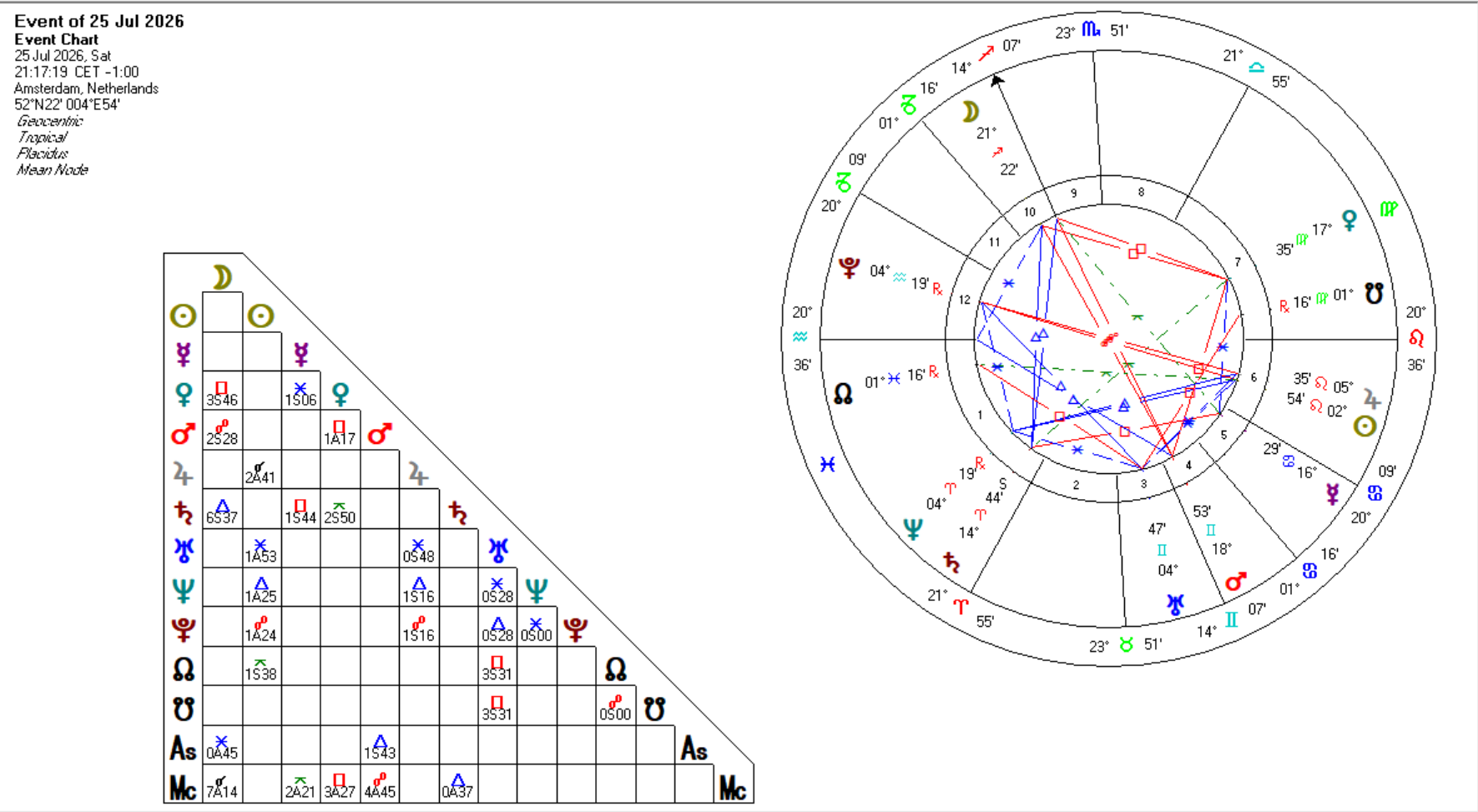
July 25, 2026 – Saturn stations retrograde at 14° Aries
On July 25, Saturn begins its annual retrograde period, this time at 14° Aries. It will slip back to 7°55' Aries by December 10, before turning direct again and resuming its path through the fire sign. This is a slowdown within a much larger story: Saturn has been settled in Aries since February 14, 2026, following a long, hesitant transition out of Pisces that began as early as May 2025.
What does it mean when the planet of time, structure, and maturation itself appears to take a step back - and in the sign of first movement, the unguarded beginning, no less?
Saturn Retrograde in Aries: The Psychological Layer
Aries is impulse, action, the first "I want." Saturn is delay, accountability, the question "and does it hold up?" When these two meet in a retrograde phase, the question turns inward instead of outward.
Retrograde Saturn in Aries doesn't ask for a new beginning, but for an honest look at a beginning you've already made - perhaps years ago, perhaps early in life. Where did you have to stand on your own two feet early on? What form of self-sufficiency did you build out of necessity, and does it still fit who you are now? In Jungian terms: this is an invitation to revisit your own inner authority - not the authority you took over from outside, but the authority you built yourself, step by step. Become your own parent, not by pushing harder, but by looking more honestly at what already works and what is merely old behavior.
A Look Back in History: When Was Saturn Here Before?
Saturn takes about 29.5 years to complete a full orbit. That means it returns to roughly the same early degrees of Aries every 29-30 years - and sometimes, after two orbits (nearly 59 years), to almost exactly the same degree, even in the same month. Two earlier passages through this area are worth examining.
July 1967 - Almost the Exact Same Degree, 59 Years Ago
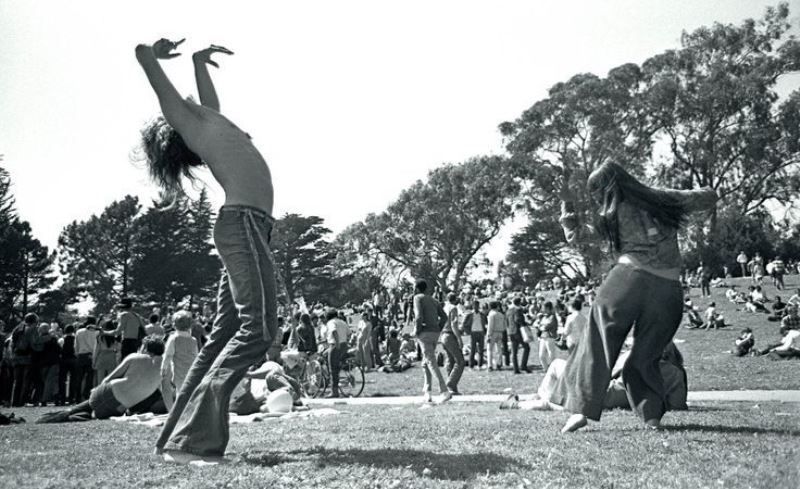
Saturn entered Aries on March 3, 1967, and stayed there, with the usual course corrections, until April 29, 1969. Its station midway through that year fell on almost the same early Aries degrees as now. The world that year: the Six-Day War in the Middle East (June 1967), race riots in Newark and Detroit (July 1967) that raised questions about structural inequality and authority, and China's Cultural Revolution hardening further. At the same time, there was the "Summer of Love" in San Francisco - a generation pushing back against existing structures and searching for its own, unauthorized form of identity. The larger Saturn-in-Aries theme: where is the line between claiming autonomy and taking responsibility for the consequences of doing so?
1937-1940 - The Shuffle Between Pisces and Aries
This may be the most telling parallel, because the pattern so closely resembles what Saturn is doing now. On April 25, 1937, Saturn entered Aries for the first time, only to slip back into Pisces on October 17 of that year. It didn't re-enter Aries until January 14, 1938, and only moved on for good into Taurus on March 20, 1940. Saturn took nearly three years to truly commit to Aries - precisely as it is doing now (a first, brief visit to Aries in 2025, a retreat back to Pisces, and only settling in for good in February 2026). The years 1937-1940 were a period in which fragile, newly built international structures came under enormous pressure in the run-up to the Second World War - a time when old forms of authority collapsed and new, harder structures had to prove themselves.
And If Saturn Retrograde Is in Your Birth Chart?
Apart from this transit, it's worth pausing on what it means if Saturn was retrograde at the moment you were born. This tends to be underestimated in practice, but it can point to an innate sense of inadequacy - a deeply felt vulnerability around self-worth that was there from the start, before life had even had the chance to cause it. Not something that arose from an event, but something woven into the structure itself.
That early, inner doubt about one's own adequacy often looks for a way out through overcompensation. Working hard to prove you're allowed to be here, making yourself indispensable, building an achievement that's beyond all doubt. Underneath that drive sits an exaggerated need for recognition from the outside - a kind of external proof meant to demonstrate what was never quite felt from within. The trouble is that outside recognition rarely truly resolves that inner sense of inadequacy; it tends to silence it only temporarily. The real work of Saturn retrograde in the birth chart lies in gradually acknowledging that vulnerability itself, rather than simply drowning it out with achievement.
This current retrograde passage is therefore a recurring movement in the direction of natal transiting Saturn in the sky.
What This Historical Thread Teaches Us
The pattern that keeps recurring is this: Saturn retrograde in Aries rarely coincides with quiet times. It coincides with moments when something just built - a regime, an identity, a new structure - has to prove itself again, often under pressure. Not because the foundation was wrong, but because it hadn't yet been tested.
For your own chart, the question isn't only "what's beginning anew," but: what have you built recently (in the past two years, since Saturn's first step into Aries), and is it now being put to the test? This retrograde isn't a punishment. It's the repetition needed to find out whether a foundation truly holds.
From Jupiter to Pluto: The Slow Planets as a Map for Growth
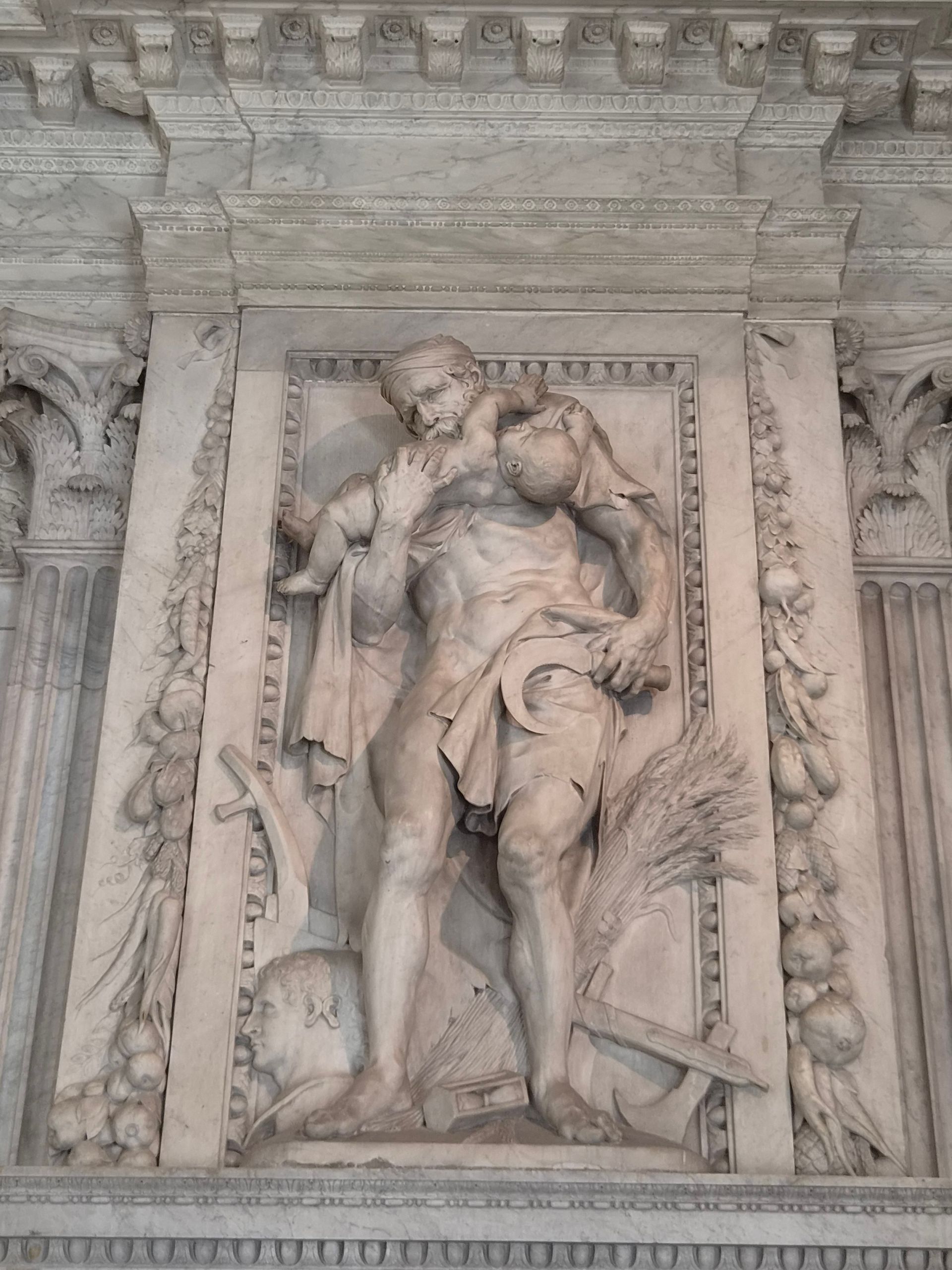
Cronus - the Greek god the Romans called Saturn - once received a prophecy: one of his children would dethrone him, just as he himself had once dethroned his own father. Out of fear, he devoured, one by one, every child Rhea bore him, the moment it was born. Only with the sixth, Zeus, did Rhea intervene: she wrapped a stone in swaddling clothes and had Cronus swallow that instead, while secretly raising the infant elsewhere. Years later, Zeus forced his father to give back everything he had held inside him all that time - his brothers and sisters emerged again, unharmed.
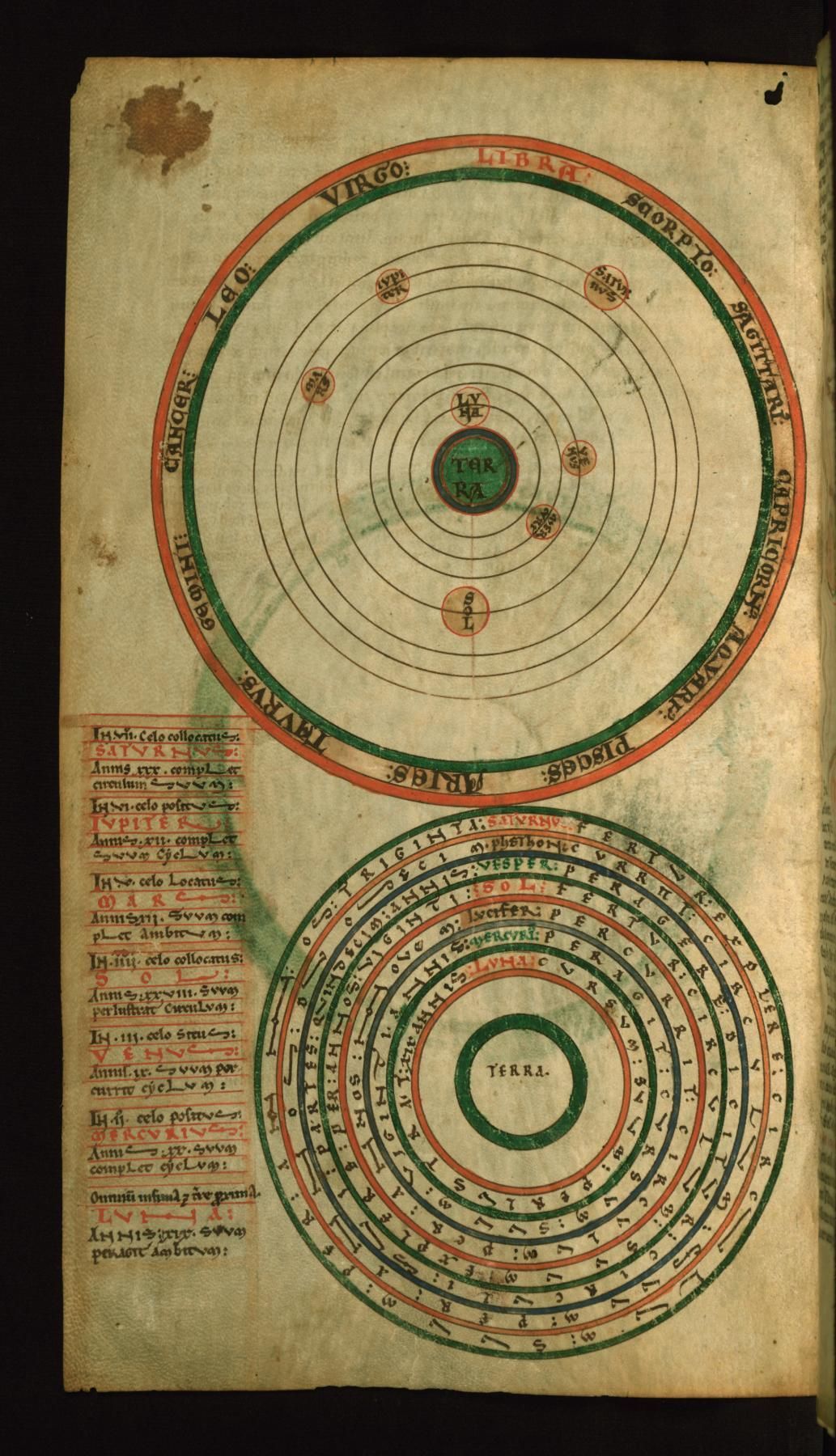
This image - a father who takes his own children into himself out of fear of what they will one day become - is an early, raw version of exactly what Saturn does in the psyche: holding on, containing, postponing, out of fear of what might happen if it's released too soon. This retrograde doesn't stand alone, then. It's part of a larger family: the slow planets, from Jupiter through Pluto, each of which illuminates a different layer of our development. Where the fast planets steer daily mood and action, these slow movers trace the phases through which a person actually grows.
Jupiter unfolds the phases in which vision condenses into insight - I wrote about this at greater length earlier, in my blog post on the Jupiter cycle. Saturn illuminates the degree of our causal awareness: how much do we understand about the consequences of our choices, and how much responsibility are we willing to carry for them? Uranus breaks through the boundaries that limit us and opens the capacity for abstraction, for thinking beyond the familiar pattern. Neptune is about letting go and touching a cosmic consciousness larger than the personal. And Pluto, finally, governs the deepest psychological processes: original leadership, and the slow, often uncomfortable work of integrating the shadow.
Saturn and the Squares: The Architecture of Maturation
Within this family, Saturn may be the planet that moves most tangibly with our life course - precisely because its nearly 29.5-year cycle presents itself to us at fixed angular moments: the squares and the opposition.
Saturn's first square to itself falls around age 7-8. Early childhood is over by then; we start school and begin developing our own form of autonomy in the world - the first time we have to function outside the family according to rules we didn't make ourselves.
Around age 14-15 comes the Saturn opposition. Here we're confronted with what it means to carry responsibility for our life over the longer term - the degree of responsibility that comes with secondary school, and with entering long-term friendships that are no longer a given. The primary-school child gives way to a young adult in the making, who slowly becomes acquainted with society, its workings, and their own role within it.
Around age 21-22, Saturn reaches its second square. By then we're well on our way toward adulthood - the parental nest has usually been left, and we carry most of the responsibility for our own existence. Yet this is still a transitional phase: we sometimes fall back on our nest of origin for advice, support, or reassurance, even though it's no longer the natural living environment.
When the Saturn return arrives around age 29, we have usually already encountered the impermanence of life more than once - through relationships, work, or studies that turned out to be finite. We've had the chance, through trial and error, to learn to carry this, so that we in turn come to be carried by life ourselves.
It's no accident that it's ultimately Zeus, the child, who forces his father to give back what he held onto for years - not an act of destruction, but of liberation: the brothers and sisters emerge again, unharmed. Seen this way, every Saturn angle is not an attack on what already exists, but an invitation to finally release what had long been ready to come out. This retrograde is not an isolated moment, but one step in a much older choreography - one that we all dance, generation after generation.
Want to know how this transit plays out specifically in your birth chart - which house, which aspects, which themes exactly are touched? Feel free to get in touch.
#SaturnRetrograde #SaturnInAries #Astrology #JungianAstrology #PsychologicalAstrology #Transit2026 #SaturnCycle #PersonalGrowth #LifeStages #ContemplationsOnSpirit