Contemplations on Spirit
'In this blog I contemplate the means to understand one self and the motivation that moves us to unfold in heart and soul.'
Drishti - दृष्टि
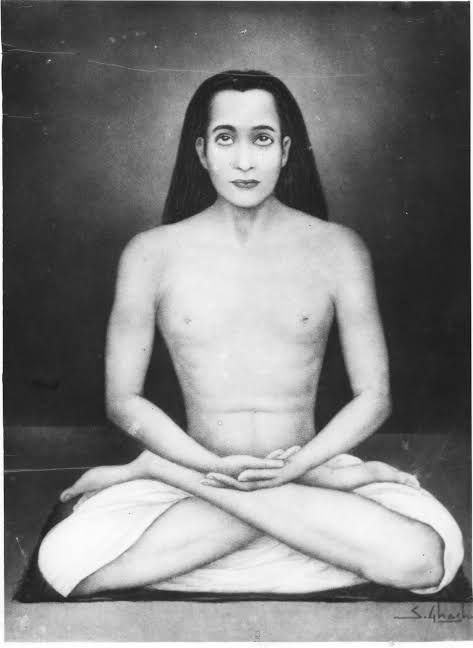
"Om Mahavataraya Vidmahe Jagadguru-Devaya Dhimahi Tanno Babaji Prachodayat"
This is about the Vedic Arts and how it dawns on me in this life like an everlasting sunrise, cyclically returning me back to source: posture practice, Asana, and the planetary configurations.
Drishti in Asana Practice: Pratyahara, Dharana and Dhyana
The art of Drishti is a means of pratyahara - sense withdrawal - enhancing Dharana and Dhyana. Dharana is focus, and Dhyana is absorption. When you practice a posture in Asana practice, you find a Drishti focus - the direction in which one anchors the balance of your posture. That is significant for Drishti. When Drishti is fixed, it stabilizes the posture, so that due to the anchor of focus, the body can remember balance and remain still. Even though there are several forms of Drishti, the soft fixed gaze is by far the one I encounter most in practice.
Drishti is a directional focal point held - where your eyes rest while you're in the pose. It's brief, and its job is to anchor balance and support Dharana in that moment. You move through many drishtis across a practice (nose-tip, thumb, navel, etc., depending on tradition/pose). Not easy for everyone. A gateway to practice can be Trataka meditation. Trataka is a dedicated, standalone concentration practice, not tied to a posture. You sit still and gaze steadily - usually at a candle flame - without blinking, for a sustained period (the Bihar School version is specifically done at night on a flame). The goal is stopping the dissipation of mind and improving concentration - it's not a byproduct of doing something else, it is the whole practice. Bihar School also uses it as eye therapy, distinct from any asana context.
Drishti is a gaze you hold within another practice; trataka is a gaze that is the practice. Trataka is really a more formalized, matured version of the same principle - sustained one-pointed gazing pushed to the point where it becomes its own meditation (ekagrata, single-pointedness), rather than just a stabilizing aid.

Trataka
Swami Niranjanananda Saraswati
Trataka means to gaze, and it is an important practice of pratyahara. It is the last practice of pratyahara, which leads to dharana.
In trataka the mind is fixed right from the word ‘go’ on an object, a visual object. In your practice of yoga nidra, you go through a gradual introversion. From body awareness you move to sound awareness, then to rotation of consciousness through body parts, breath awareness, and so on. You gradually go deeper, withdrawing the mind from its external associations and connections. In trataka it is one hit, you are there, you have to be there, for there is no gradual movement to concentration. You have to have that state of concentration right from the word ‘go’.
Different methods of trataka
Trataka is a visual practice and it uses sight to bring about a state of concentration. It uses vision to still the dissipations of the mind, and therein lies its beauty.
There are many methods of practising trataka and each brings about a different experience. For therapy purposes the method is different, for achieving mental concentration the method is different, for psychic experience the method is again different. You work from where you are and gradually go up.
It is believed that trataka opens up the human psyche. It activates ajna chakra, due to which you begin to foresee things; you become the seer of events. That, however, is the final attainment of trataka. In the primary class of trataka, it is practised for two purposes: therapy of the eyes and concentration. When you begin to have a little blurriness in the vision and notice that you need to hold the paper away from yourself, at that time if you practise trataka regularly for six months your eyesight will get better. That is how trataka is used for therapy purposes.
For the purpose of concentration, to stop the dissipation of mind and improve concentration, trataka on a candle flame is practised at night. One has to look at it without flickering the eyelids. That is the rule of trataka: while you are looking at something you cannot flicker the eyelids. The moment you have the urge to blink or move the eyes for any other reason, you have to stop the external gazing, close the eyes, look at the after-image, and remain with the eyes closed until that inner image disappears.
If you close your eyes and remain with the eyes closed for five minutes, your brainwaves will change. They will become alpha waves. Then, when you open your eyes and reconnect with the world, the brainwaves will again change instantly, as the shapes, forms and colours are being again recognized and absorbed. At that moment beta waves will predominate.

Drishti in the Horoscope: The Gaze of the Planets
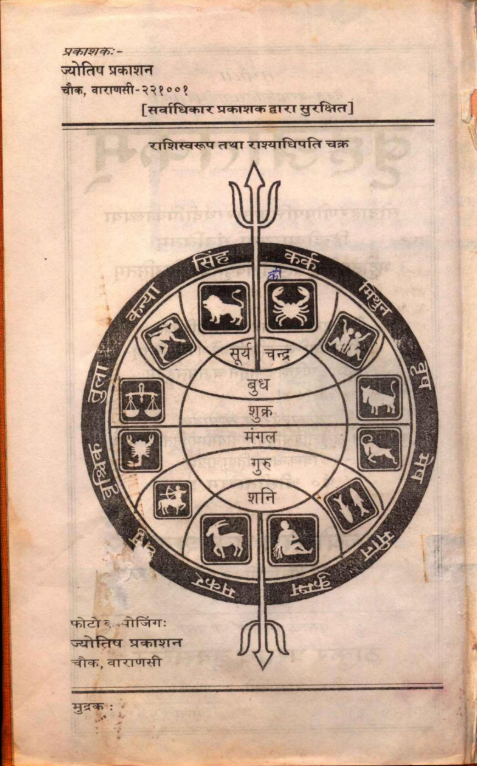
Planetary configurations in Jyotisa too are Drishti - the gaze of planets towards certain realms in the chart and towards one another. Drishti is not always effective; the position of the planet matters in relation to the gaze towards other planets, mutual gaze between each other, or a gaze towards a realm of life. That gaze also determines the effect the planet has on the receiving end - a realm, or another planet. In the birth chart there is an inborn gaze amongst the planets in a certain configuration, which is called a horoscope. These planets are positioned in certain realms of life, and those are also included in the gaze aspect.
Kendra and Trikona: The Western Aspects
In western tropical astrology the equivalent of Drishti would be aspects, though it's not called that - the major and minor aspects astrologers consult to see the relation planets have amongst the inborn natures. There are a couple of differences: certain aspects in western astrology are not taken into account in the Vedic Arts, and certain angles are similar, or the same. The effect and meaning of the angle is kind of similar.
Kendra would be similar to a square, representing some form of action in this lifetime. Trikona would be an indicator of past life karmas and the totality of karma - prarabdha karma and sanchita karma, respectively.
Confirmation and Echo
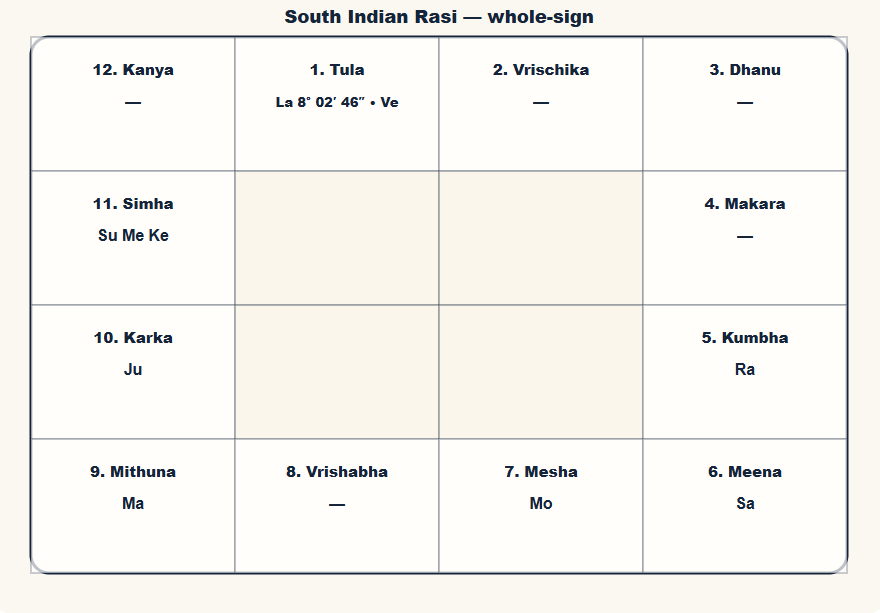
Above you see a South Indian chart of September 2nd in 2026 at noon, that is today. You can see Jupiter, Brihaspathi in the 10th realm passing the gaze of Saturn, Sani at the 6th realm. You can calculate this here. When we look at the inborn nature - the birth chart - there is a natural tendency of Drishti. A natal planet can then receive a temporary gaze, a temporary aspect, from a transiting planet. For example, there is an aspect in the birth chart between Brihaspati and Shani, Jupiter and Saturn. If that aspect is temporarily confirmed by a transiting Saturn - transiting Saturn gazing toward this same configuration - the effect is emphasized, and it requires us to acknowledge and become aware of what we have already done with the inborn Saturn, the natal Saturn. Even if the transiting graha involved do not “gaze at” or aspect the natal graha, the temporary connection that echoes back an inborn quality will stir up this theme in one's chart.
When you have a certain inborn nature of Drishti, a certain inborn focus, these are deeply ingrained tendencies and therefore part of our nature. When there is a certain beneficial or malefic temporary Drishti happening in transit - for example, the exact trine between Jupiter and Saturn in transit on September 1st - that is for everyone, that is collective. If there is something in your own inborn Drishti that confirms this temporary Drishti in any way, it makes the experience of a temporary collective transit very personal.
With Saturn very strong in the chart, there is a big sense of responsibility, a big tendency to feel lesser than, to be melancholic or to see a lot of risks, and therefore feel limited or restrained at some point or in some way due to the strong need for sustainability - despite the uplifting, expansive nature of the temporary Jupiter involved. And vice versa: if the inborn Jupiter, Brihaspati, is strongly placed, it will give space and insight to the regulations of Saturn. Given the inborn nature, this temporary Drishti is received in a very different way.
Looking at the inborn nature and inborn traits of a horoscope, Drishti is only a little piece, because there is much more to take into account. However, when there is a certain strongly placed configuration, that is also due to the Drishti of the involved planets and realms. That is always the starting point to receive the current collective transits.
Transits
The first exact Jupiter-Saturn trine of this cycle falls on September 1, 2026, with both planets at 19°27' in their respective signs - Jupiter exalted in Cancer, in Ashlesha nakshatra, and Saturn in Pisces, retrograde, in Revati nakshatra. This is precisely a trikona relationship through the water element: Cancer, Scorpio, and Pisces sit four signs apart from one another (the 4th, 8th, and 12th from Aries), placing Cancer and Pisces in trikona with each other.
The gandanta point holds true as well: the shared Mercury rulership of both nakshatras - Ashlesha for Jupiter, Revati for Saturn - adds an analytical, communicative dimension to the trine. And both nakshatras are, fittingly, the final nakshatra of their water sign, sitting right at the classical threshold into the following fire sign (Ashlesha - Magha, Revati - Ashwini). These are two of the three classical gandanta zones in the nakshatra system.
There are three such points altogether, each formed by the final padas of a water sign's last nakshatra meeting the opening padas of the fire sign that follows:
- Ashlesha - Magha (Cancer - Leo)
- Jyeshtha - Mula (Scorpio - Sagittarius)
- Revati - Ashwini (Pisces - Aries)
Astrologically, this is considered a point of crisis and transformation - the element of water (dissolution, feeling, the unconscious) meets fire (action, will, the conscious) head-on. A planet sitting exactly on a gandanta degree is regarded as vulnerable or unstable: there is no solid ground beneath it, as if suspended between two worlds before something new can be born. Hence the “knot” imagery - it names a point that still needs to be untied.
Both Jupiter (in Ashlesha) and Saturn (in Revati) sit at exactly this kind of threshold during the trine - adding a layer of “something passing through a narrow crossing” on top of the trine's own natural harmony.
Thanks for reading
xx Melanie
090226