Contemplations on Spirit
'In this blog I contemplate the means to understand one self and the motivation that moves us to unfold in heart and soul.'
From Serpent to Throne
Mercury, Jupiter and the Lamps of Diwali
Mercury Looks Back
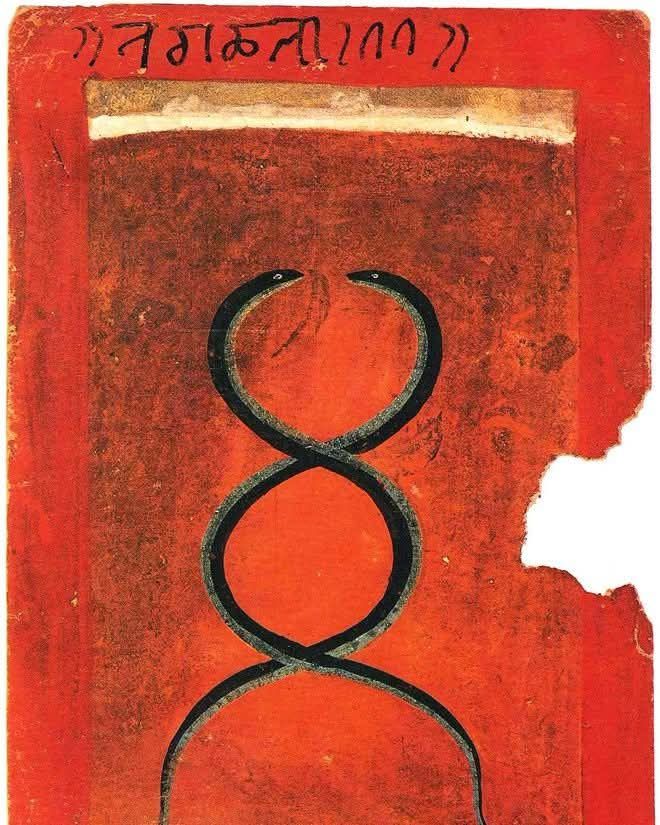
On Saturday 24 October, at around a quarter past nine in the morning Amsterdam time, Mercury comes to a standstill at 26°45' sidereal Libra, in Vishakha. Then he walks backwards, until he turns again on 13 November in Swati, at 10°48'. From 30 October to 10 November he also disappears into the light of the Sun - combust, as we say in Jyotish. The messenger falls silent in the very week of Diwali.
What makes this retrograde special is where it happens. Mercury stands in Vishakha, the nakshatra of Jupiter. At the same time Jupiter stands in Aslesha, the nakshatra of Mercury. They are lodging in each other's house. Until 31 October the teacher and the messenger are, as it were, looking through each other's window.
The myth: Budha, child of the Moon and of the guru's wife
That is no coincidental pairing. The Puranas tell how Mercury was born, and it is a story about Jupiter. Soma, the Moon, had completed his great royal sacrifice and stood at the height of his power. Wealth and splendour went to his head. In that intoxication he carried off Tara, the wife of Brihaspati, the guru of the gods.
Brihaspati demanded her back, but Soma refused. What began as a household disgrace grew into a war that tore the three worlds apart: the Tarakamaya, the war over Tara. Shukra, teacher of the asuras and Brihaspati's old rival, took the side of the Moon. Rudra and the gods stood behind the guru. Heaven and earth trembled, until Brahma himself stepped between the parties and forced Soma to give Tara back.
Tara returned to Brihaspati's house, but she was pregnant. Brihaspati would not let the child grow inside her and demanded that she cast it out. She laid it down in a thicket of reeds, and the child that appeared there shone so brightly that it outshone the gods themselves. Now both Brihaspati and Soma wanted to be the father.
Tara kept silent, out of shame. The child grew angry at her silence and wanted to curse her, until Brahma calmed it and took Tara aside to ask who the father was. In a whisper she named Soma. The Moon embraced his son, and Brahma gave him his name: Budha, the wise one, the awakened. Later Budha married Ila, and from them came Pururavas, the ancestor of the lunar dynasty.
So Mercury is the child who is not the guru's, yet was carried in his house. The child of a transgression who was nevertheless given the name of wisdom. The child who made his mother speak the truth.
That he now looks back in Jupiter's star, while Jupiter sits in his, feels like a family conversation finally taking place. And the Diwali new moon brings Budha's father, Soma, to the Sun in exactly that star.
What still needs to be said, read or set right once more before you can move on? Let new decisions wait until after 13 November; use these weeks to look back on what you have learned since August.
The Guru Leaves the Serpent
On Saturday 31 October, at around half past seven in the morning here, Jupiter steps from sidereal Cancer into Leo, and from Aslesha into Magha. It is the first time since 2015 that he enters Magha. He leaves his exaltation in Cancer behind, and with it the safe, nourishing role that suited him so well there.
Since 19 August Jupiter has been moving through Aslesha, the star of the serpents. In early October he crossed the degree of the 12 August solar eclipse. From 8 to 30 October he stood in the gandanta, the knot where water turns into fire.
The myth of Aslesha:
the thousand sons of Kadru
Aslesha means embrace. Her deities are the Sarpas, the serpents, and the Adi Parva of the Mahabharata tells where they came from.
The sage Kashyapa had two sisters as wives, Kadru and Vinata, both daughters of Daksha. When he offered them a boon, Kadru asked for a thousand sons, all equally mighty. Vinata asked for only two, but stronger than all her sister's sons together.
Kadru laid a thousand eggs, Vinata two. They were kept warm in jars for five hundred years. Then Kadru's eggs broke open, and a thousand serpents crawled out: Shesha, Vasuki, Takshaka and all their brothers. Vinata's eggs stayed closed.
In her impatience and jealousy Vinata broke open one of her eggs. Inside lay her son Aruna, but only his upper body had formed; his legs were still missing. Aruna cursed his mother: because she had woken him too early, she would be the slave of the woman she competed with for five hundred years. Only her second son could free her, if she let him ripen in peace. Then Aruna rose up and became the charioteer of the Sun - the red glow of dawn.
So the serpents were born out of rivalry between sisters, and the curse of slavery was spoken before anything had happened. That is Aslesha: bonds that already exist before you see them, and the price of impatience. A guru who lives in that star for three months learns something about holding on - about loyalty that binds, and about knowledge you only gain once you have felt the grip of something.
The myth of Magha:
Yama and the path of the fathers
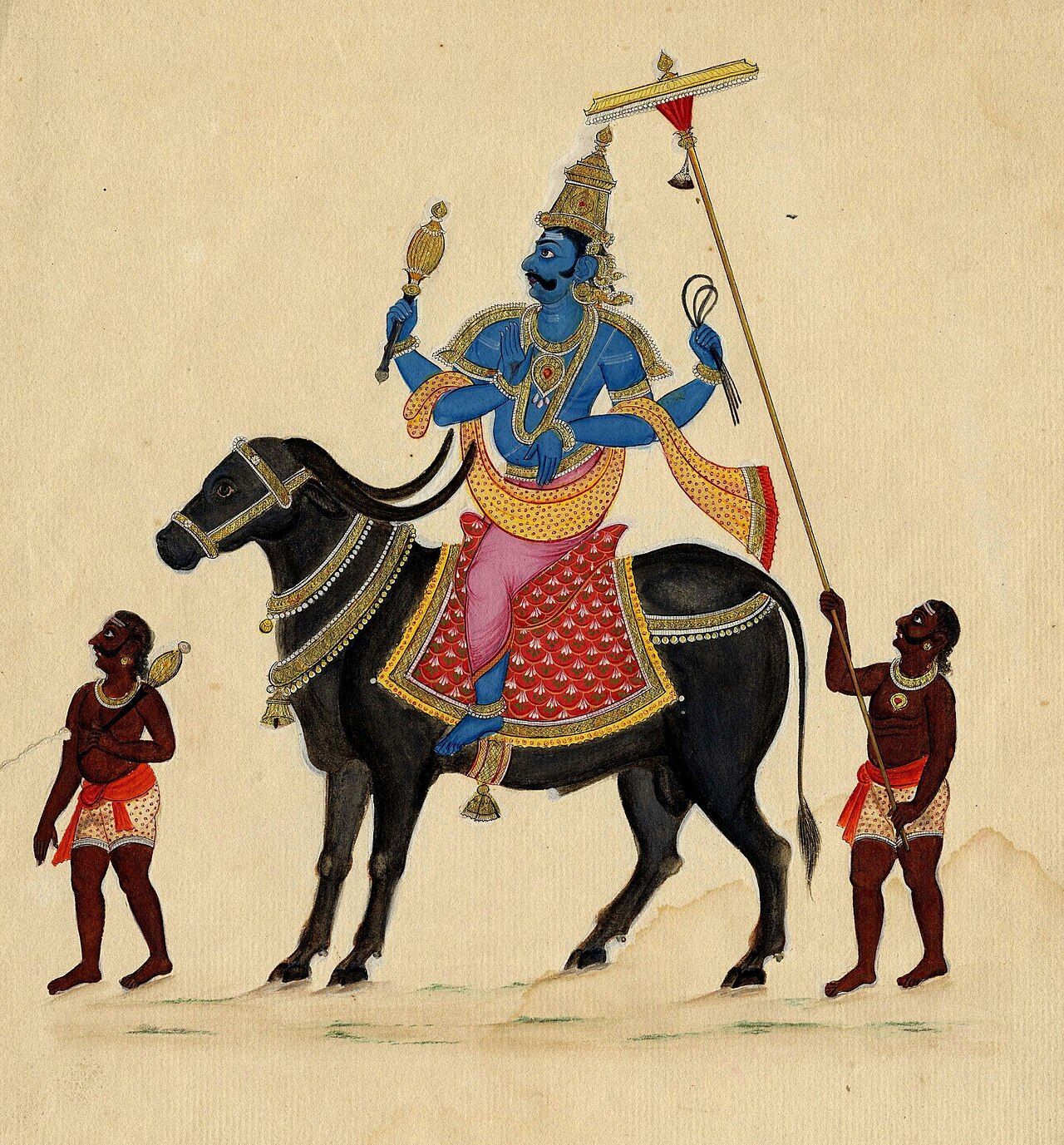
Magha is the throne. Her deities are the Pitaras, the ancestors, and here lies one of the oldest stories of the Vedas. In the Rig Veda (10.14)
Yama is the first mortal who died. He was the first to cross the great streams, he searched out the way for many, and he found the path the fathers have walked ever since. Whoever dies after him follows his track to the highest heaven, where Yama feasts with the ancestors.
In the hymn the dead person is addressed: go along the ancient paths our fathers went, join Yama and the fathers, leave what is imperfect behind and return home. Two four-eyed dogs guard the way. The next hymn (10.15) invokes the Pitaras themselves: the near and the far, the known and the forgotten, and asks them to come to the offering.
That ancient path runs straight through Diwali. On Dhanteras a lamp is set facing south for Yama, and the lamps of Diwali show the ancestors the way back. The Skanda Purana prescribes that when the Sun stands in Libra, people should raise torches at dusk to show the ancestors the way back to their world.
Magha's name means the bountiful, the mighty - related to Maghavan, an epithet of Indra. Ketu has been waiting here since March; Ketu is the lord of Magha and is therefore at home. Until 5 December guru and Ketu sit together on the throne of the lineage: the teacher beside the headless body that can only feel what it once knew.
This is only the first visit - on 13 December Jupiter turns, in January he falls back into Aslesha, and only in June 2027 does he truly take the throne.
The Loss of Shri - the New Moon in Vishakha
On Sunday evening 8 November the Hindu world celebrates Diwali, the night of Lakshmi at the new moon of Kartika. The exact conjunction falls the following morning, Monday 9 November at around eight o'clock, when Sun and Moon stand together in Vishakha. On the festive evening itself the Moon is still just in Swati.
Vishakha means: with two branches. Forked. Her deities are Indra and Agni together - the king of the gods and the fire of the offering.
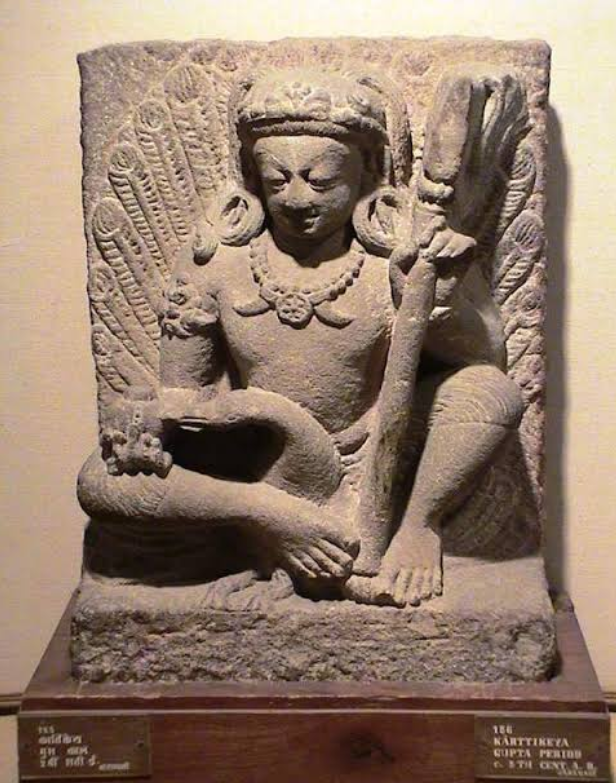
The myth of Vishakha: the thunderbolt in Skanda's side
In the Vana Parva of the Mahabharata the sage Markandeya tells how Skanda was born. Agni, the fire, had fallen in love with the wives of the seven sages. Svaha, who loved Agni, took on the form of those wives six times and received his seed. She cast it into a golden pool on the white mountain, and from it a child with six heads was born. Within a few days it was fully grown. When it cried out, the worlds trembled. He received many names: Skanda, Kumara, Guha, Mahasena.
The gods grew afraid. They urged Indra to kill the child before it surpassed their king. Indra hesitated, for he sensed that victory was uncertain. Still he marched out, mounted on his elephant Airavata, with the whole army of the gods behind him. Skanda breathed flames towards them, and the gods fled and left Indra alone.
Then Indra hurled his vajra, the thunderbolt. It pierced Skanda's right side and passed straight through him. From that wound a second figure arose: a youth with a club in his hand and a celestial amulet. Because he was born from the splitting by the thunderbolt, he was named Vishakha. He looked like the consuming fire itself.
Indra was so frightened that he begged Skanda for protection with folded hands. Skanda reassured him. Later Indra and the gods even offered the six-day-old child sovereignty over heaven. Skanda refused: Indra was to remain king. Instead the gods anointed him commander of their army and hung a golden garland, made by the celestial smith, around his neck. Agni gave him a red cockerel as his banner.
The wound became a second birth. And the rival became an ally. That is Vishakha: the split that serves a goal, the power that divides itself rather than grasping.
The myth of the loss: Durvasa's garland
In the Vishnu Purana the ascetic Durvasa wanders the earth, in a state of ecstasy from a vow he is keeping. He meets a vidyadhari, a nymph of the air, wearing a garland of heavenly flowers. The scent fills the whole forest. Durvasa asks her for the garland, and she gives it to him with a bow.
Durvasa wears the garland on his head and walks on, like one possessed. Then he sees Indra approaching on his elephant Airavata, surrounded by the gods. Durvasa takes the garland from his head and throws it to the king. Indra catches it and places it on his elephant's head. Airavata, drawn by the scent, seizes the garland with his trunk, sniffs it and throws it to the ground.
Durvasa flares up in anger. Puffed up by your power, he says, you have not honoured the garland I gave you, in which Shri dwelt. Just as you have cast that garland to the ground, so shall your sovereignty over the three worlds be brought down. Indra immediately dismounts and begs forgiveness. Durvasa refuses. He is, he says, a man who knows no remorse - and he walks on
From that moment the three worlds lose their strength. Herbs and plants wither, offerings are no longer made, the ascetics cease their austerities. Lakshmi withdraws into the Ocean of Milk. The asuras see their chance, attack the weakened gods and defeat them. Indra and the gods flee to Brahma, with Agni, the fire, leading the way. Brahma sends them on to Vishnu.
Indra and Agni. The two gods of Vishakha are precisely the two who lost Shri and went looking for her. This year the Diwali new moon falls in their star.
Which garland have you once let fall to the ground, without noticing what lived in it?
The myth:
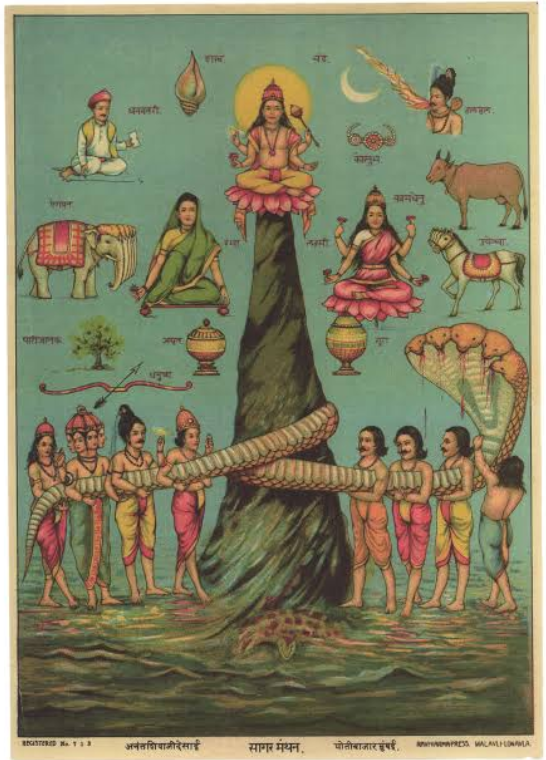
the churning of the Ocean of Milk
Vishnu's answer to the loss is strange: "churn the Ocean of Milk, and do it together with your enemies. Make peace with the asuras, he tells the gods, throw all the healing herbs into the ocean, and promise them a share of the amrita. I will make sure they do not drink it."
The gods try to pull Mount Mandara out of the ground, but it is too heavy; many are crushed. Vishnu lifts it and sets it in the middle of the ocean. Vasuki, the king of the nagas, is wound around the mountain as the churning rope, after he too has been promised a share of the spoils.
Then the question of who pulls where. Vishnu takes Vasuki by the head, and the asuras protest: the tail is beneath their dignity. So they get the head and the gods the tail. That was the plan all along. Fiery breath bursts from Vasuki's mouth, scorching and weakening the asuras. The same breath drives clouds towards the tail, where they give rain that refreshes the gods
.
They churn, and the mountain sinks into the seabed. Vishnu becomes a gigantic tortoise, Kurma, and carries the mountain on his back. The Vishnu Purana says that at that moment he is everywhere at once: as a tortoise beneath the mountain, as a god among the gods, as an asura among the asuras, and on the summit to hold it steady.
Here Aslesha returns. Vasuki is the serpent who has to bear the tension between the opposites. He is pulled back and forth by two parties who do not trust each other, and without him nothing happens.
The poison
The first thing to rise from the ocean is not a treasure. It is halahala, a poison that spreads in every direction and begins to burn the worlds.
Gods and asuras flee. No one can stop it. They go to Shiva.
Shiva takes the poison in his hand and drinks it. Parvati holds his throat so it sinks no further. The poison stays in his neck and turns it blue; since then he has been called Nilakantha, the blue-throated one. The Bhagavata Purana adds a detail: a few drops fell from his hand, and they were taken up by snakes, scorpions and poisonous plants. That is how the poison came into the serpents.
The poison is not thrown away. It is carried, in the place between head and heart.
Kadru, Garuda and the forked tongues
From the same ocean rises the white horse Uchchaihshravas. One evening the sisters Kadru and Vinata see the horse in the distance. What colour is he, asks Kadru. White, says Vinata. Kadru says the tail is black. They wager: whoever loses becomes the other's slave. The next morning they will go and look.
That night Kadru orders her thousand sons to cling to the horse's tail as black hairs. Some of them refuse. Kadru curses them: they will burn in the great serpent sacrifice of King Janamejaya. Brahma lets the curse stand, because the serpents have become too numerous and too venomous. The others obey. In the morning the tail is black, and Vinata becomes a slave, as Aruna had foretold.
Then Vinata's second egg breaks open, in its own time. Garuda emerges, so radiant that the gods take him for Agni. He has to carry the serpents on his back wherever they wish to go. One day he asks what the price of his mother's freedom is. The serpents answer: bring us the amrita.
Garuda flies to heaven. He passes through a ring of fire, through a wheel of blades spinning around the nectar, past two serpents whose gaze paralyses. He seizes the amrita, but does not drink it himself. Vishnu sees this selflessness and grants him a boon; Garuda becomes his mount. Indra hurls his vajra at him. Garuda is unharmed, but out of respect for the thunderbolt he lets a single feather fall. Indra and Garuda become friends.
Garuda places the amrita on a bed of kusha grass and tells the serpents: first take a ritual bath, then you may drink. Vinata is free. While the serpents bathe, Indra carries the nectar back to heaven. The serpents return and lick the grass where the amrita lay. The sharp edges of the kusha grass split their tongues. That is why serpents have forked tongues, and why kusha grass is sacred.
The serpents win the wager by clinging - and lose everything that follows: the nectar, their whole tongue, and later some of their number in the fire.
On Diwali itself Mars is still in Aslesha. Jupiter has gone, but the serpent is not empty; there is still fire in the water.
The myth: Shri rises
Only once the poison has been carried does the ocean yield its treasures. In the Vishnu Purana Surabhi rises first, the cow of plenty, source of milk and sacrificial butter. Then Varuni, goddess of wine, with rolling eyes. Then the Parijata, the heavenly tree whose fragrance fills the worlds. Then the apsaras, the heavenly dancers. Then the Moon, which Shiva takes into his hair. Then Dhanvantari, dressed in white, holding in his hands the bowl of amrita.
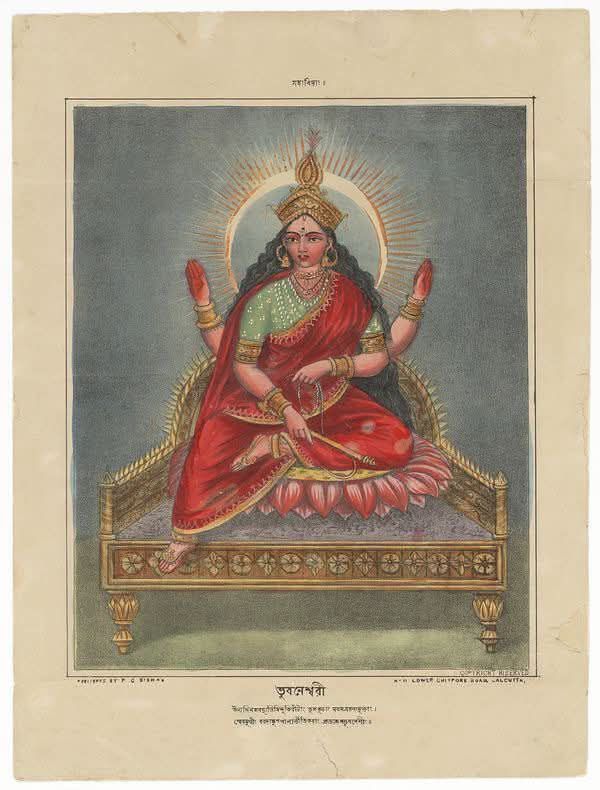
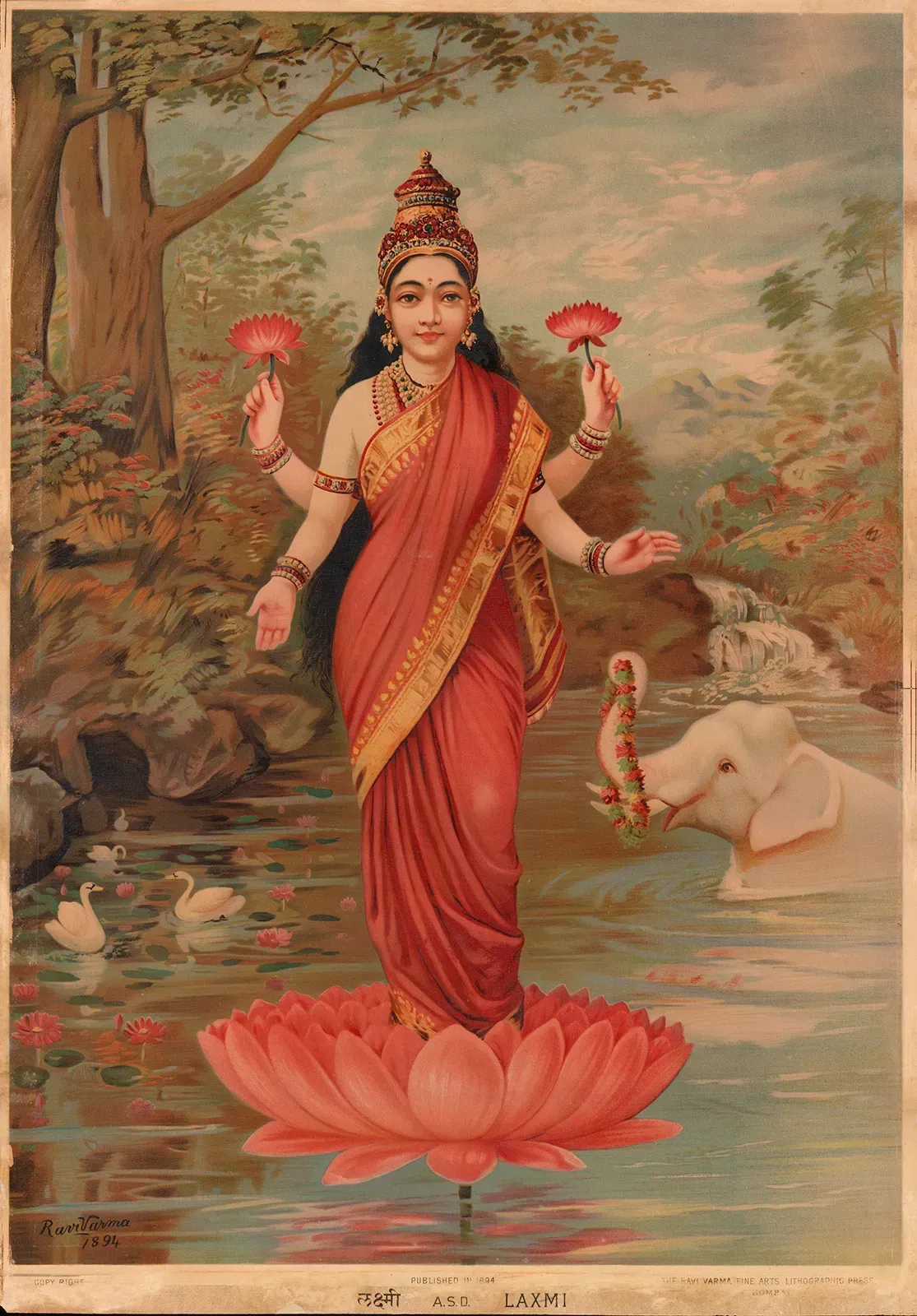
And then, radiant, Shri rises from the waves, seated on a lotus in full bloom, a lotus in her hand. The great sages sing to her with the hymn dedicated to her - the Shri Sukta. The gandharvas sing, the apsaras dance. The Ganga and the other sacred rivers come to bathe her. The elephants of the four quarters take up water in golden vessels and pour it over her. That is how she is still shown in Indian images: Gaja-Lakshmi, the goddess between two elephants.
The Ocean of Milk itself gives her a garland of flowers that never fade. Vishvakarma, the celestial smith, adorns her with jewels. Then she looks around among gods and asuras, and throws herself upon the breast of Vishnu - the one who lay down beneath the mountain. There she remains. The gods are happy again, herbs and plants revive, the offerings are made once more. Indra sings her praise and asks her two things: that she never again leave the three worlds, and that she never leave whoever sings this hymn. She promises both.
In the Vishnu Purana Dhanvantari appears before Lakshmi, in the Bhagavata Purana after her; the order differs between sources.
That is why Diwali already begins on Dhanteras, Friday 6 November: the day of Dhanvantari, who rose from the ocean with the amrita - and who in India is regarded as the founder of Ayurveda. On Sunday 8 November comes Lakshmi Puja. Houses are cleaned, lamps are lit, the door is left open. Shri only comes where it is bright and receptive.
Postscript: Mohini, Rahu and Ketu
The asuras, abandoned by Shri, are enraged. They snatch the bowl of amrita from Dhanvantari's hands. Then a woman of unimaginable beauty appears among them: Mohini, the enchantress - Vishnu in female form. The asuras let her divide the nectar. She seats gods and asuras in two rows, and pours the amrita only for the gods.
One asura, Svarbhanu, sees through it. He disguises himself as a god and sits down in the row, right between the Sun and the Moon. He receives the nectar and drinks. At that moment the Sun and the Moon recognise him and point him out. Vishnu hurls his discus, and it strikes off Svarbhanu's head - just before the amrita has passed his throat.
The head has drunk of the nectar and can no longer die. It falls roaring from the sky and becomes Rahu. Ever since he has borne an eternal grudge against the Sun and the Moon. At every eclipse he swallows them - but because he has no body, they always slip out again. In the later Puranas and in Jyotish the body becomes Ketu: without head, without eyes, only feeling what it once knew.
On Diwali the Sun and the Moon - the informers - stand together in Vishakha. And Ketu sits with Jupiter on the throne of Magha. The headless body sits beside the guru.
The churning myth is found in the Mahabharata, the Ramayana and the Puranas. The Vedic layer is the Shri Sukta, the hymn to Shri in the appendices of the Rig Veda, which is still recited at Diwali.
Mercury Turns
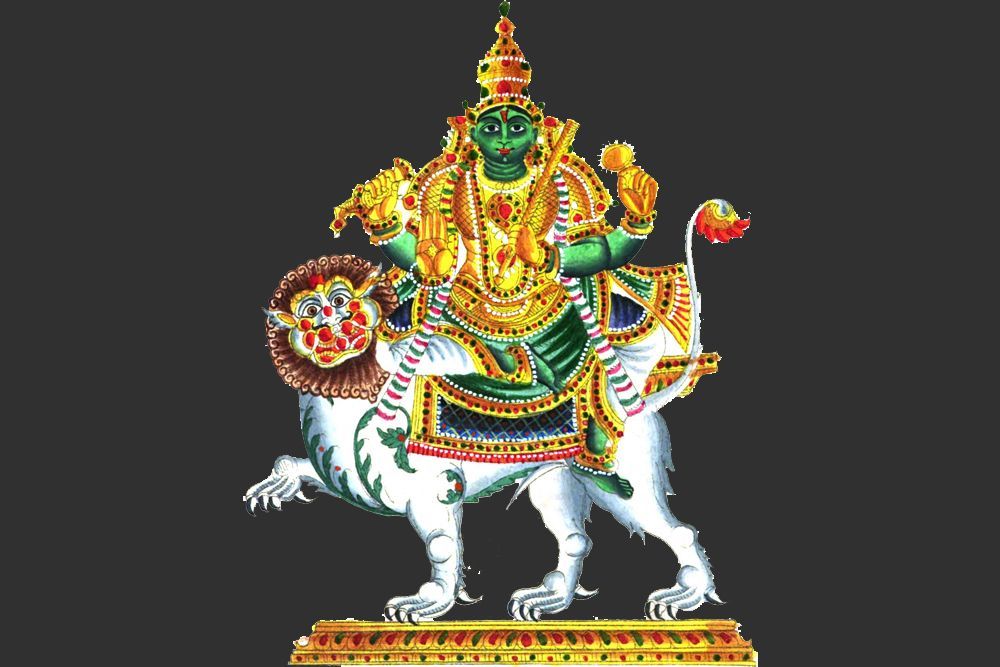
On Friday 13 November, at around five in the afternoon Amsterdam time, Mercury comes to a standstill once more and moves forward, at 10°48' Libra in Swati - the star of Vayu, the wind. Venus follows a day later. What has been bent back for three weeks begins to flow again.
The messenger has looked back in the house of the guru. The guru has let go of the serpent and sits beside Ketu on the throne of the ancestors. In the star of Indra and Agni, on the darkest night, a lamp has been lit for a goddess who once vanished because no one saw what lived in a garland.
The story of Diwali is not that light wins. It is that light returns - when we keep churning together with our opposites, when someone is willing to carry the poison, when we let go of what we clung to, and when we only take the throne once we know who sat on it before us.
What do you still need to dare to carry before something precious can return to you?
Thanks for reading xx,
Melanie 102426
Bibliography
- Rig Veda 10.14 (Yama) and 10.15 (the Pitaras); Shri Sukta (Rig Veda, khila).
- Shatapatha Brahmana 3.6.2 - Kadru and Suparni, trans. J. Eggeling (SBE 26).
- Taittiriya Brahmana 1.5.1 and 3.1 - nakshatra deities and wishes.
- Mahabharata, Adi Parva - the churning of the ocean, Rahu, Kadru and Vinata, Garuda, trans. K.M. Ganguli.
- Mahabharata, Vana Parva 3.215-217 (Ganguli 3.223-227) - Skanda and Vishakha; Shalya Parva - the four forms of Skanda.
- Valmiki Ramayana, Bala Kanda 45 - the churning of the ocean.
- Vishnu Purana 1.9 - Durvasa, the churning, Lakshmi Stuti, trans. H.H. Wilson; Vishnu Purana 4.6 - the birth of Budha.
- Bhagavata Purana 8.6-8.9 (the churning, halahala, Lakshmi, Mohini, Rahu and Ketu) and 9.14 (Budha).
- Skanda Purana - the churning; the torches for the ancestors.
- Padma Purana - the churning.